Use it. Build on it. Embed it.
One engine, three depths. Most knowledge work isn't code — tret meets your team where it is, and devs everywhere else.
01 · use it
The workbench your team runs today.
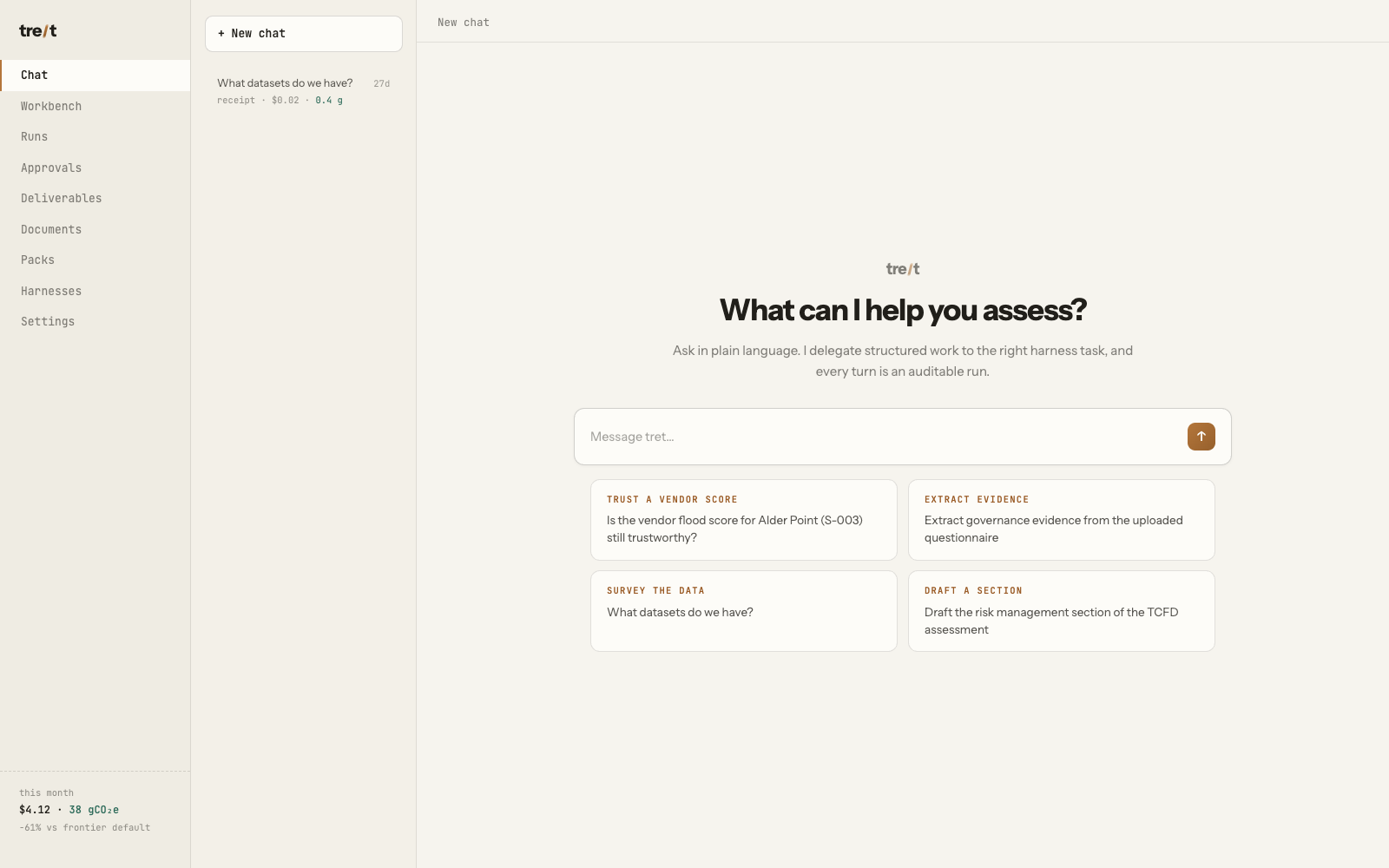
Colleagues hand it plain-language tasks — memos, filings, pipelines. Every run is routed, logged, and receipted. No terminal required.
02 · build on it
Like Claude Code — a harness for knowledge work.
The workbench is just the reference UI. Underneath is the harness — same routing, same receipts, your front end. Be the person who greens your org's AI.
$ tret run "summarize the 40 filings in ./q3"
→ task profiled · extraction, long-context, no frontier needed
→ routed to qwen3.8 · −71% cost · −68% CO₂e vs default
✓ summary written to q3-filings.md
receipt · $0.021 · 0.4 gCO₂e · ledger #b7a2
03 · embed it
The orchestrator inside your product.
Route your agents' calls through tret and ship the receipts to your own users — cost and carbon accounting as a feature, not a promise.
# your agent product
from tret import Router
result = Router().run(task)
result.receipt # $ and gCO₂e, per call